
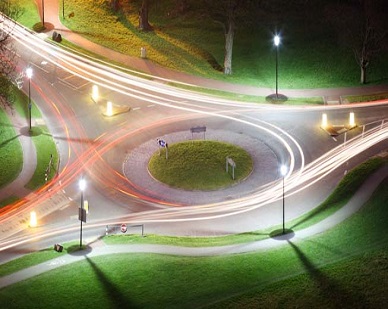
Roundabouts Part 3: 5 PDH
$30.00
This is part III of a three-part series. The third course covering the final chapters 6, 7, & 8 of Roundabouts: An Informational Guide from the Federal Highway Administration. In this course the student will learn the many different ways to design a roundabout and what steps are taken to ensure the most efficient and safe roundabout for a given location. Also covered are the signage requirements, landscaping potential, and multi-roundabout systems that can be used when designing a roundabout.
SPECIFIC KNOWLEDGE OR SKILL OBTAINED
This course teaches the following specific knowledge and skills:
- Design principles
- Geometric elements
- Double-Lane, rural, and mini-roundabouts
- Traffic design
- Signage, markings, and illumination
- Other design considerations
- Crash prediction models
CERTIFICATE OF COMPLETION
You will be able to immediately print a certificate of completion after passing a 30 question multiple-choice quiz. The quiz can be retaken unlimited times until a passing grade of 70% or better is earned. This course satisfies five (5) continuing education hour (CEH)/professional development hour (PDH) of continuing education.
Related Courses
Sustainable Concrete Pavements: 5 PDH
$30.00 Add to cartIn this course the student will understand concrete pavement sustainability concepts and recommended practices for maximizing the sustainability of concrete pavements.Instructor: Raymond Bosek, PESPECIFIC KNOWLEDGE OR SKILL OBTAINED
This course teaches the following specific knowledge and skills:
- Explain sustainability and how it applies to concrete pavements
- Discuss pavement sustainability concepts
- Describe concrete pavement design attributes enhancing sustainability
- Recite sustainable concrete pavement materials
- Recognize construction issues related to sustainability
- Identify concrete pavement renewal practices
- Discuss economic and environmental analyses of sustainable concrete pavements
CERTIFICATE OF COMPLETION
You will be able to immediately print a certificate of completion after passing a 20 question multiple-choice quiz. The quiz can be retaken unlimited times until a passing grade of 70% or better is earned. This course satisfies five (5) hours of professional development (PDH).
Preview CourseClick “Preview Course” to view prior to purchaseClick “Add to Cart” to purchase
Roundabouts Part 2: 5 PDH
$30.00 Add to cartThis is part II of a three-part series. The second course covering chapters 3, 4, & 5 of Roundabouts: An Informational Guide from the Federal Highway Administration. This course provides an in-depth look into planning a roundabout and what factors to account for when designing it. Also, it covers what is necessary to operate a successful roundabout and the cause and effect of different features. Last, you will understand the differences in safety between roundabouts and signalized intersections.Instructor: Raymond Bosek, PEThis is part II of a three-part series. The second course covering chapters 3, 4, & 5 of Roundabouts: An Informational Guide from the Federal Highway Administration. This course provides an in-depth look into planning a roundabout and what factors to account for when designing it. Also, it covers what is necessary to operate a successful roundabout and the cause and effect of different features. Last, you will understand the differences in safety between roundabouts and signalized intersections.
SPECIFIC KNOWLEDGE OR SKILL OBTAINED
This course teaches the following specific knowledge and skills:
- Planning and design of roundabouts
- Comparing operational performance
- Space and economic evaluations
- Traffic operations
- Performance Analysis
- Safety and statistics
- Crash prediction models
CERTIFICATE OF COMPLETION
You will be able to immediately print a certificate of completion after passing a 30 question multiple-choice quiz. The quiz can be retaken unlimited times until a passing grade of 70% or better is earned. This course satisfies five (5) continuing education hour (CEH)/professional development hour (PDH) of continuing education.
Preview CourseClick “Preview Course” to View Prior to PurchaseClick “Add to Cart” to Purchase and Access Quiz