

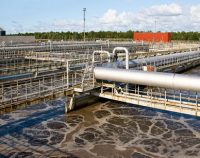
Wastewater Treatment Plants: 1 PDH
$6.00
Package plants are pre-manufactured wastewater treatment facilities typically used to treat flows between 0.01 and 0.25 MGD. This course provides information about three types of package plants, extended aeration, sequencing batch reactor and oxidation ditch systems. General configuration, typical applications for each, advantages and disadvantages, typical performance, and cost are covered.
SPECIFIC KNOWLEDGE OR SKILL OBTAINED
This course teaches the following specific knowledge and skills:
- General configuration of extended aeration, sequencing batch reactor, and oxidation ditch package plants
- Typical applications for extended aeration, sequencing batch reactor, and oxidation ditch package plants
- Advantages and disadvantages of extended aeration, sequencing batch reactor, and oxidation ditch package plants
- Design criteria for extended aeration, sequencing batch reactor, and oxidation ditch package plants
- Typical performance and costs of extended aeration, sequencing batch reactor, and oxidation ditch package plants
CERTIFICATE OF COMPLETION
You will be able to immediately print a certificate of completion after passing a 10 question multiple-choice quiz. The quiz can be retaken unlimited times until a passing grade of 70% or better is earned. This course satisfies 1 professional development hours (PDH) of continuing education.
Related Courses
Fuel Cell Technology and Performance: 4 PDH
$24.00 Add to cartIn this course the student will understand the fundamental principles, design, operation, and performance characteristics of various fuel cell technologies, including their system components, fuel processing, and real-world applications.Instructor: Seth Grablow, PESPECIFIC KNOWLEDGE OR SKILL OBTAINED
This course teaches the following specific knowledge and skills:
- Explain fuel cell electrochemical operation principles.
- Compare different fuel cell types and characteristics.
- Evaluate performance parameters and efficiency losses.
- Analyze system components and balance-of-plant requirements.
- Assess modeling approaches and system optimization strategies.
- Interpret fuel cell application data and deployment scenarios.
CERTIFICATE OF COMPLETION
You will be able to immediately print a certificate of completion after passing a 20 question multiple-choice quiz. The quiz can be retaken unlimited times until a passing grade of 70% or better is earned. This course satisfies four (4) hours of professional development (PDH).
Preview CourseClick “Preview Course” to view prior to purchaseClick “Add to Cart” to purchase
Carbon Absorption of Volatile Organic Compounds: 3 PDH
$18.00 Add to cartCarbon adsorption is used in air pollution control to remove volatile organic compounds (VOCs) from low to medium concentration gas streams, when stringent outlet concentration must be met and/or recovery of the VOC is desired. This course covers the types of adsorbers, adsorption theory, and design procedures for carbon adsorption equipment.Instructor: Seth Grablow, PECarbon adsorption is used in air pollution control to remove volatile organic compounds (VOCs) from low to medium concentration gas streams, when stringent outlet concentration must be met and/or recovery of the VOC is desired. This course covers the types of adsorbers, adsorption theory, and design procedures for carbon adsorption equipment.
SPECIFIC KNOWLEDGE OR SKILL OBTAINED
This course teaches the following specific knowledge and skills:
- The types of carbon adsorption equipment and which are in most common use
- Define an adsorption isotherm and be able to recognize the equation for the Freundlich isotherm
- Adsorber sizing parameters
- Make adsorption and desorption time calculations
- Procedures for estimating carbon requirements
- Cost estimation procedures for carbon adsorption systems
CERTIFICATE OF COMPLETION
You will be able to immediately print a certificate of completion after passing a 20 question multiple-choice quiz. The quiz can be retaken unlimited times until a passing grade of 70% or better is earned. This course satisfies 3 professional development hours (PDH) of continuing education.
Preview CourseClick “Preview Course” to View Prior to PurchaseClick “Add to Cart” to Purchase and Access Quiz
